1. The Digital Trap: Why You’re Tired of Tab-Switching
It’s late 2025, and our professional lives are exhausted by digital drudgery. Think about your workday. How much time are you actually spending on high-value, creative work? For most knowledge workers, the answer is “not enough.”
We are constantly caught in a cycle of tedious admin: booking flights, cross-referencing calendars, copying data from a spreadsheet to a presentation, and managing an overflowing inbox. We’ve become highly paid switchboard operators, routing digital traffic between a dozen different apps. This leads to what experts call decision fatigue. By the time you get to the important task—the strategic plan, the creative pitch—your brain is already running on empty.
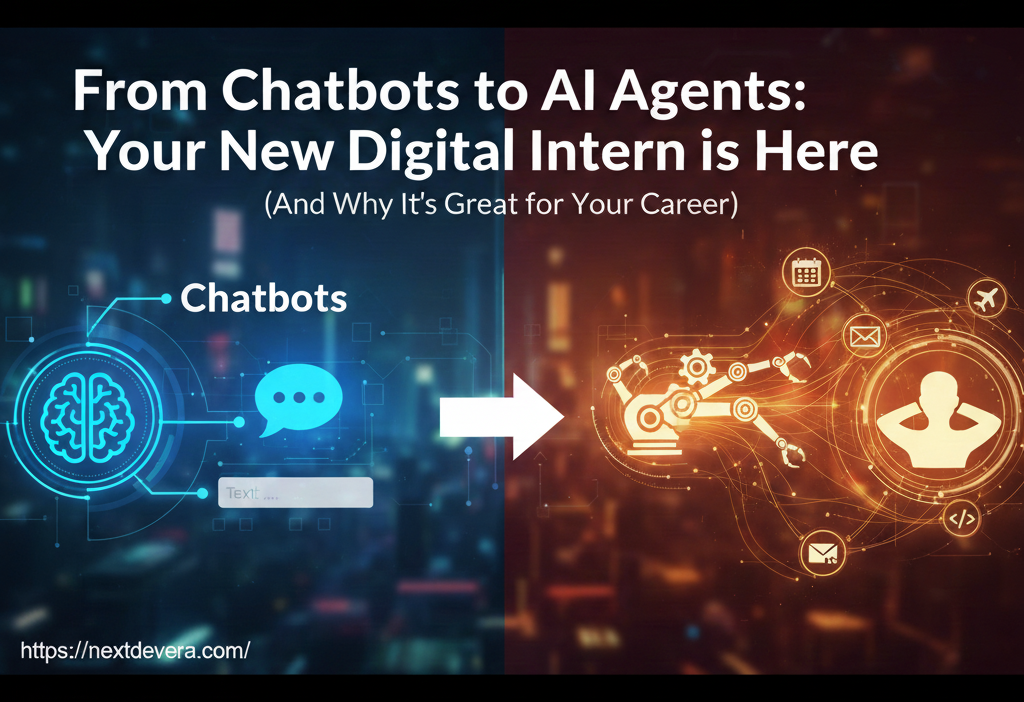
For the last three years, the revolution was driven by Chatbots. Tools like ChatGPT were amazing conversationalists. They could generate ideas, write code snippets, and answer complex questions. But they were passive. You had to ask them a question, and they gave you an answer. They lived and died within the text box. The chatbot could give you a recipe, but it was up to you to buy the ingredients and turn on the oven.
2. The Great Leap: What is “Agentic AI”?
The game has fundamentally changed. The biggest AI trend for 2026 is the shift from passive tools to proactive AI Agents.
An AI agent is not just an advanced chatbot; it’s a digital workforce. You don’t give it a question; you give it a goal. It doesn’t just respond with text; it takes action. It has been equipped with a “toolbox” that allows it to interact with the outside world—your email, your calendar, third-party apps, and even the live web.
The Agentic AI process works in a continuous, multi-step loop that mimics human reasoning:
- Goal: You tell the agent, “Plan my team’s Q1 kickoff event.”
- Plan: The agent breaks this huge task down: Check budget, find 3 venue options, check team availability, draft an invite.
- Action: It uses its tools (browsing, calendar APIs, email access) to execute the plan steps.
- Observation: It finds a conflict or a low-rated venue.
- Re-Plan & Execute: It autonomously adjusts its plan and executes new steps until the goal is met.
This is why AI automation is a massive buzzword: the agents handle the complex, multi-step logistics entirely on their own, only returning to you for the final, high-level approval.
3. Your New Personal AI Assistant: Real-World Agent Examples
This is where the fear of “AI taking my job” gives way to the relief of “AI taking my busywork.” Personal AI Assistants are already restructuring how we handle administrative tasks.
3.1. The Ultimate Travel Agent (and Admin)
In the old world, booking a trip or even scheduling a complex meeting was a major time sink. You had to be the human glue, jumping between sites.
In the world of Agentic AI, you simply state your complex intent:
“Book a weekend trip to a warm climate in the next four weeks for under $1,500 total. Ensure the hotel has a high-speed Wi-Fi rating and book a reservation at a top-rated local restaurant for Saturday night.”
The agent then works silently. It sifts through hundreds of flight and hotel combinations, cross-references prices, reads user reviews, checks your calendar for conflicts, and even attempts to negotiate small discounts. It packages all the complex data into a single, clean itinerary and asks you just one thing: “Shall I confirm and book?”
This transformation collapses four hours of soul-crushing admin into a 30-second review.
3.2. The Silent Coder and Content Creator
The impact on professional roles is immense. For software developers, the AI agent is no longer just autocompleting lines of code. It is now able to handle entire tickets: A developer can assign a bug report—”Fix the broken image link on the user profile page”—and the agent will diagnose the code, write the fix, run all the required tests, and submit the corrected code for review while the human is away. This is a game-changer for increase productivity with AI.
Similarly, a marketing manager can task an agent: “Draft a social media campaign for the new product launch, targeting users in the UK and Australia, and pre-schedule the posts for optimal engagement times.” The agent will research cultural nuances, draft 10 different versions of the copy, source relevant images, and automatically integrate with the scheduling tool.
4. The Human Advantage: Why This Is Great for Your Career
The central takeaway is not replacement; it is liberation. When the AI agents take over the heavy lifting of execution, what is left for the human? The truly valuable work.
4.1. Focus on Deep Work
The most in-demand skill of the next decade will be Deep Work—the ability to focus without distraction on cognitively demanding tasks. You are paid for your unique insights, your strategic thinking, and your creativity. You are not paid to copy-paste information or chase down scheduling conflicts.
By offloading the “shallow work” to your personal AI assistant, you reclaim the mental energy necessary to focus on innovation, complex problem-solving, and human connection—the very things that drive promotions and career growth.
4.2. The Shift from Doing to Directing
Your role is changing from that of a worker to a manager of AI. The future of work won’t reward those who are the fastest typists or the best at manipulating spreadsheets. It will reward those who are the best at:
-
Problem Formulation: The ability to clearly define a complex goal and break it down into achievable tasks for an agent.
-
Judgment and Taste: The skill of knowing whether the agent’s proposed output—be it a travel itinerary, a marketing pitch, or a piece of code—is high-quality, ethical, and aligned with your ultimate vision.
If you know how to effectively manage an AI workforce, you transform from an employee struggling with administrative overload into a highly leveraged strategist. This makes you significantly more valuable in the future of work.
5. Conclusion: Managing the Future
The evolution from simple LLMs (chatbots) to powerful, independent AI agents is one of the most exciting shifts of our time. It is a transition from a passive question-and-answer model to a proactive goal-achievement model.
The fear of AI automation is understandable, but the reality is this technology is here to automate your frustrations, not your value. Embrace Agentic AI as your new digital intern—a tireless, meticulous assistant who works 24/7 to clear your plate of drudgery. Your job isn’t disappearing; it’s simply evolving into something higher-level, more strategic, and ultimately, more human.
The only question left is: What is the first major task you are ready to delegate to your new AI agent?