
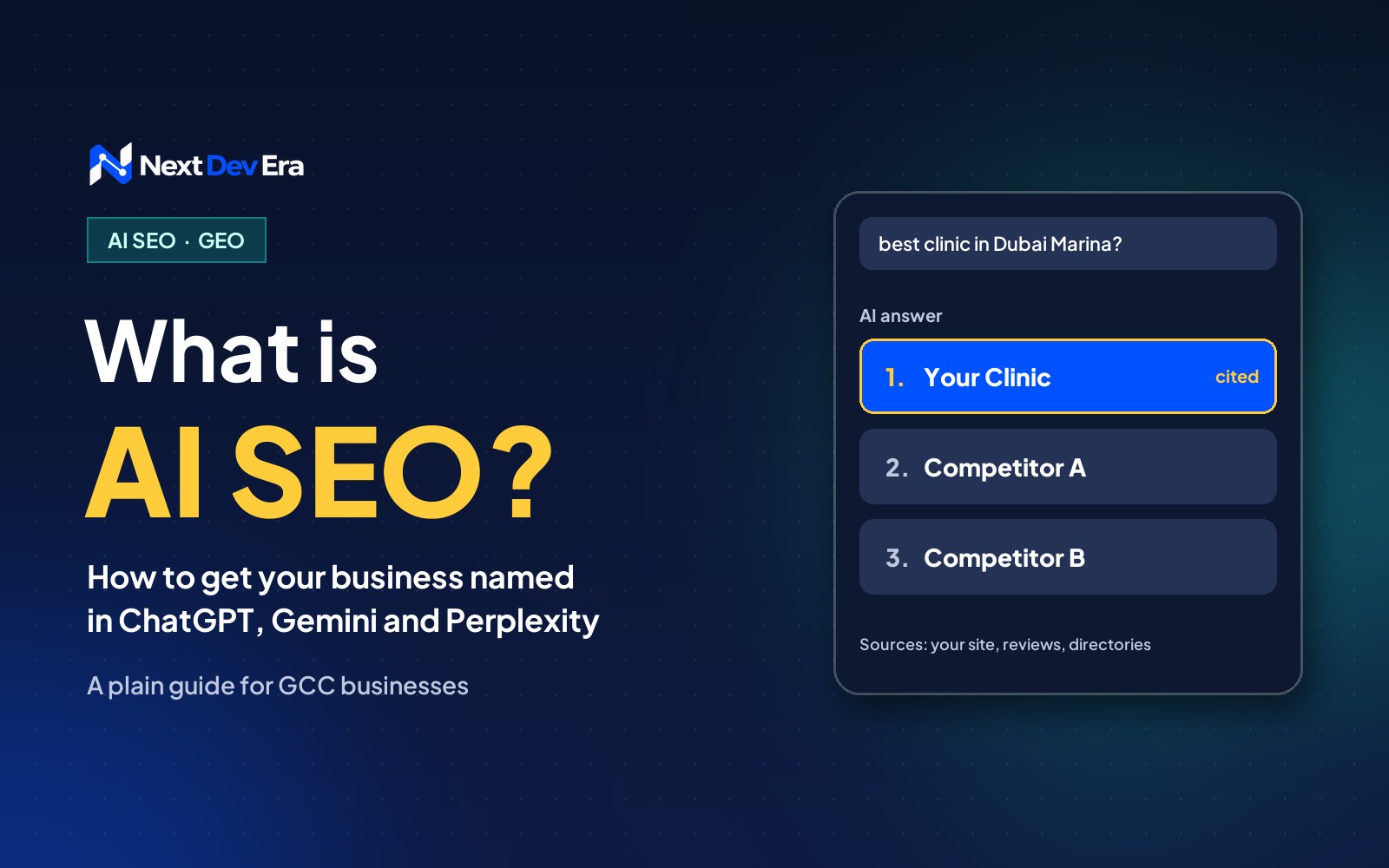
AI SEO (also called GEO) is the work of getting your business named and cited when people ask ChatGPT, Gemini, Perplexity or Google's AI Overviews for a recommendation. It builds on normal SEO, and focuses on clear answers, consistent business details everywhere, structured data and mentions on sites AI assistants trust.
More and more of your customers ask ChatGPT, Gemini or Perplexity before they ever open Google. “Best dermatology clinic in Dubai Marina.” “Which Shopify agency in Riyadh does Arabic stores?” The assistant answers with a short list of names, and if yours isn’t on it, you weren’t considered.
So what is AI SEO? It’s the work of getting your business onto that list. You’ll also hear it called GEO, short for generative engine optimisation. Same thing.
Below we explain how AI assistants decide who to mention, how AI SEO differs from the SEO you already know, and what you can start doing this month.
How do AI assistants decide which businesses to mention?
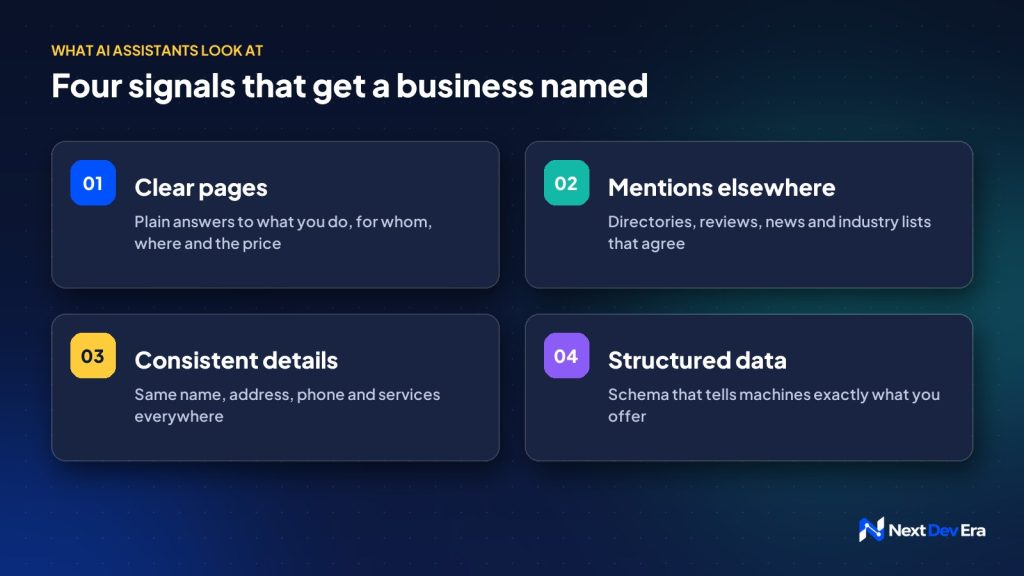
There’s no single ranking like Google’s ten blue links, but the patterns are fairly clear. AI assistants lean on three things.
The first is what they can find and read about you. Many assistants now search the web before they answer, then summarise what they found. If your website explains clearly what you do, where, and for whom, you give them something to quote.
The second is what other sites say about you. Assistants trust a business more when independent sources agree: directories, review sites, news articles, industry lists, Google Business Profile. One mention on your own site carries less weight than ten consistent mentions elsewhere.
The third is how clearly they understand you as a “thing”. AI models think in entities: a business with a name, a location, services and a reputation. If your name, address and services are described differently in different places, you’re harder to recognise, and easier to leave out.
What is AI SEO compared with normal SEO?
They overlap a lot. They share a foundation (a fast site, clear pages, good content and trusted links) and you can’t really do one well without the other. But they’re aiming at different things.
| SEO | AI SEO | |
|---|---|---|
| Goal | Rank high in Google’s results | Be named and cited in AI answers |
| Where it shows | Google and Bing results pages | ChatGPT, Gemini, Perplexity, Copilot, Google AI Overviews |
| What you track | Rankings, clicks, enquiries | How often you’re mentioned, cited and recommended for your prompts |
| What matters most | Pages matched to searches, links, technical health | Clear answers, consistent business details, mentions on other trusted sites |
Google sits in both camps now. AI Overviews, the AI summary at the top of some Google results, launched in the Middle East in 2025 and work in Arabic, so the same search can show your ranking and an AI answer above it.
If you’re starting from scratch, fix the SEO basics first. Then add AI SEO on top. It’s covered in more detail on our SEO and AI SEO service pages.
What you can do this month
You don’t need a big budget to start. These steps make the biggest difference for most businesses.
- Ask the assistants yourself. Write down ten questions a customer might ask, such as “best family lawyer in Abu Dhabi” or “Shopify developer in Jeddah”, and put them to ChatGPT, Gemini and Perplexity. Note who gets named and which websites get cited. That’s your baseline.
- Make your pages answer questions directly. Start each service page with a plain two-sentence answer: what you do, for whom, where, and roughly what it costs. AI assistants quote clear statements. They skip vague ones.
- Get your business details consistent everywhere. Use the same name, address, phone number, services and opening hours on your website, Google Business Profile, LinkedIn, and every directory you’re listed in.
- Add structured data. Schema markup (Organization, LocalBusiness, Service and FAQPage) tells search engines and AI tools exactly what your business is, in a format they don’t have to guess at.
- Earn mentions on sites assistants trust. Think regional directories, industry associations, local news, review platforms and “best of” lists. A few genuine mentions beat dozens of low-quality ones.
- Cover Arabic as well as English. Customers in Saudi Arabia in particular often ask in Arabic. Check how assistants answer your key questions in Arabic too, because the results can be quite different.
- Check again every month. AI answers change often. Re-run your ten questions and track whether you’re mentioned more.
What AI SEO can’t do
No one can guarantee that ChatGPT will recommend you. Anyone who promises that is guessing. AI answers vary from person to person and day to day, and the models change their sources over time.
What you can do is make your business easy to find, easy to understand and well spoken of across the web. That raises your chances of being named, and it helps your normal SEO at the same time.
Where to start
If you only do one thing this week, do step 1. Ask the assistants about your own category and see who they name. It’s free, takes twenty minutes, and usually makes the case for AI SEO better than anything we could write.
If you also want to put an AI assistant on your own website or WhatsApp, that’s a different job. Our guide to AI agents vs chatbots explains the options.
And if you’d like us to run the baseline for you, book a free 30-minute call. We’ll show you where you’re mentioned today and where the gaps are.

3 comments