
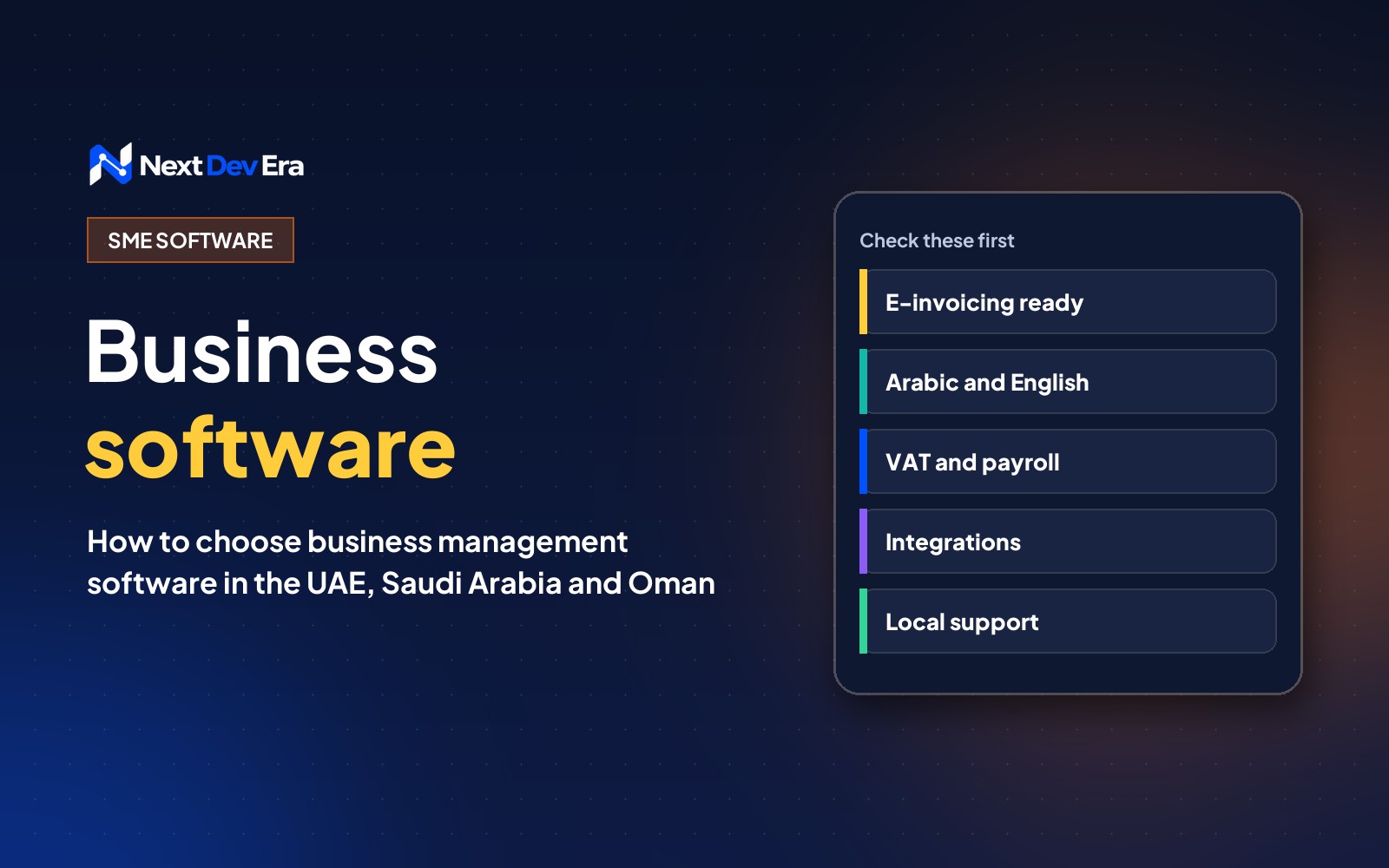
The right business management software for a GCC SME meets your country's e-invoicing rules (ZATCA Phase 2 in Saudi Arabia, the new UAE system from 2027), works in Arabic and English, handles local VAT and payroll, and connects to the tools you already use. Shortlist on those, then compare features.
The right business management software for a UAE, Saudi or Omani SME is the one that handles your invoices the way your tax authority now requires, works in Arabic and English, and connects to the tools your team already uses. Features come after that. Below is how we’d choose, the questions to ask vendors, and the common mistakes to avoid.
Start with e-invoicing
E-invoicing is now the deciding factor for many businesses in the Gulf.
- Saudi Arabia: ZATCA’s Phase 2 e-invoicing connects your invoicing system to its Fatoora platform. Businesses are being brought in by wave, based on revenue, and ZATCA notifies each wave at least six months in advance. The 25th wave starts from February 2027.
- UAE: the Ministry of Finance has announced a national e-invoicing system. A pilot began in July 2026. Businesses with revenue of AED 50 million or more must comply from January 2027, and the rest from July 2027. Businesses will need to appoint an accredited service provider.
- Oman: the Tax Authority is introducing e-invoicing too. Check its latest timeline before you choose.
If the software you’re looking at can’t meet your country’s requirements, it doesn’t matter how good the rest of it is.
What else to check in business management software
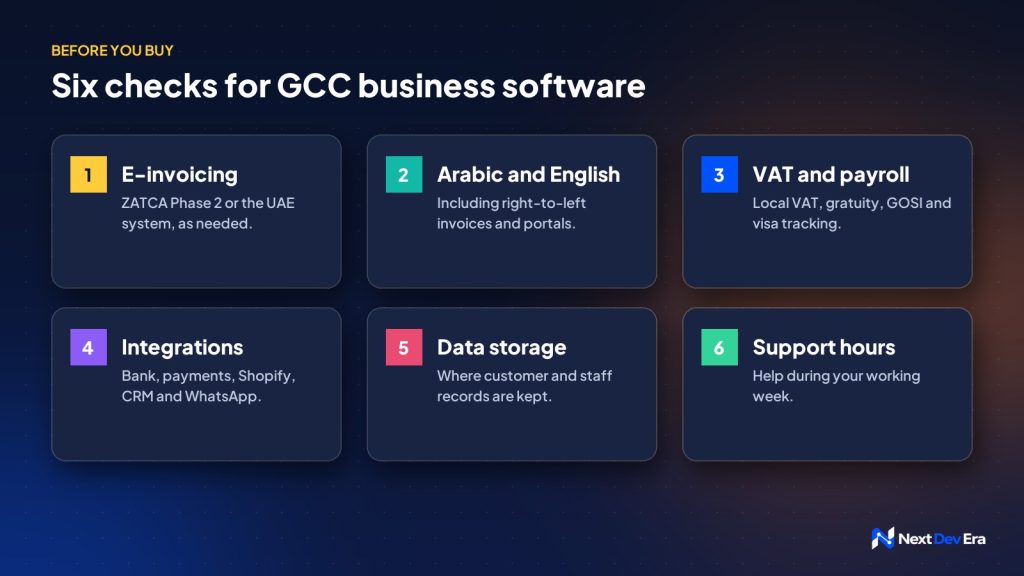
| What to check | Why it matters |
|---|---|
| Arabic and English, including right-to-left layouts | Invoices, quotes and customer messages often need both |
| VAT handling for your country | UAE and Saudi VAT rates and rules differ |
| Local payroll and HR rules | End-of-service gratuity and visa tracking in the UAE, GOSI in Saudi Arabia |
| Integrations | Your bank, payment gateway, Shopify store, CRM and WhatsApp |
| Where data is stored | Personal data laws apply to customer and employee records |
| Support hours | Help during your working week, not just the vendor’s |
All-in-one or best-of-breed?
An all-in-one system puts accounting, sales, inventory and HR in one place. It’s simpler to run and your data stays consistent. The trade-off is that each part is often weaker than a dedicated tool.
Best-of-breed means picking the best tool for each job and connecting them. You get stronger features, but you need integrations to keep data in sync. Tools like n8n can do that. See our comparison of n8n vs Zapier vs Make.
For most SMEs with under 50 staff, we’d start with an all-in-one system for finance and operations, then add specialist tools only where the built-in one really holds the team back.
Questions to ask every vendor
- Are you certified or accredited for e-invoicing in our country, and what does setup involve?
- Can we see an Arabic invoice and an Arabic customer portal, not just screenshots?
- Where is our data stored, and can we export all of it if we leave?
- Which of our current tools do you connect to out of the box?
- What does support look like on a Sunday in Riyadh or a Friday in Dubai?
- What will the total cost be for our team size in year two, not just the first-year offer?
Mistakes to avoid
- Buying for a feature list. Shortlist on the six checks above, then compare features.
- Skipping the data migration plan. Moving years of customers and invoices is often the hardest part.
- No one owning it. Someone on your team needs to be responsible for setup, training and keeping it tidy.
When off-the-shelf isn’t enough
Sometimes no product fits the way your business works. That’s why we built our own tools, like OpsDesk and StaffGrid, for operations and workforce management. If you’re stuck between products that don’t fit, book a free 30-minute call. We’ll tell you honestly whether to buy, connect or build.
